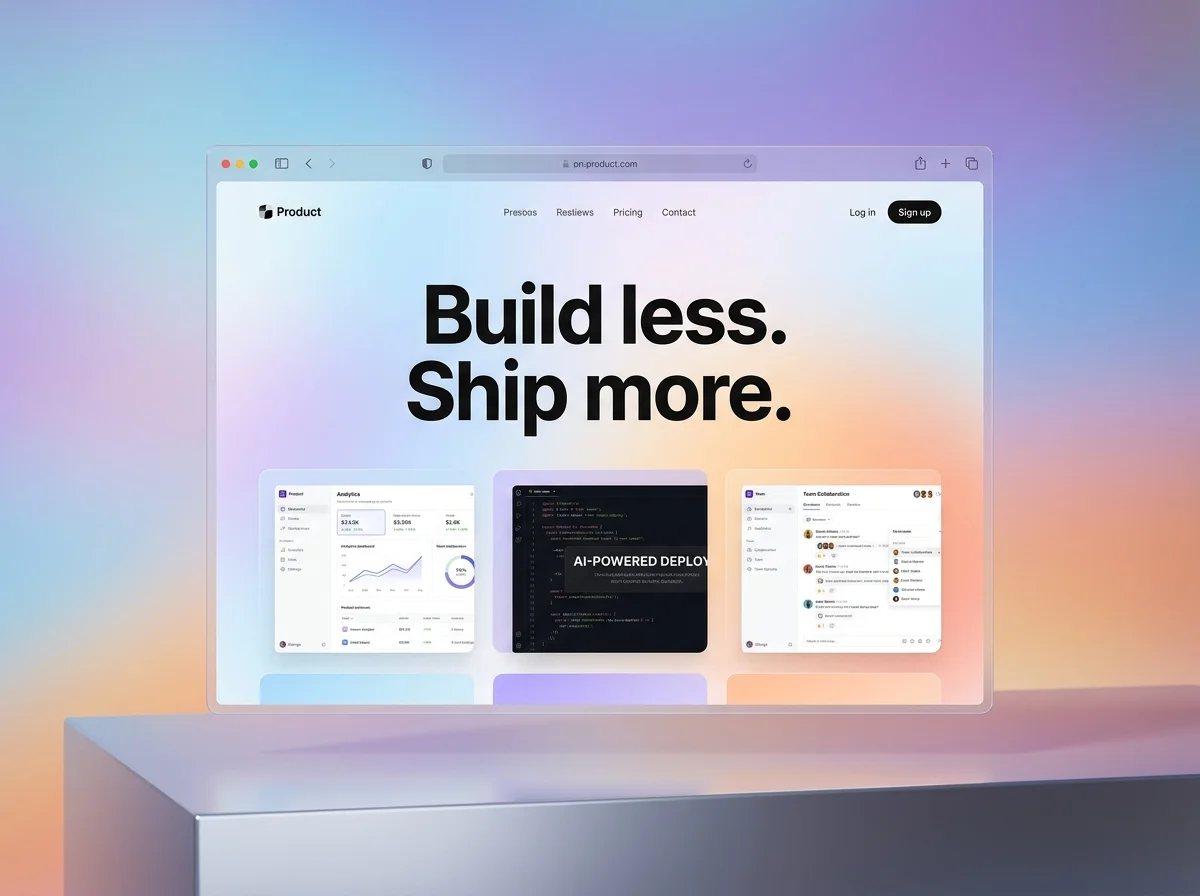
Twelve consecutive site launches now, all with Instrument Serif as the headline face. Across SaaS, fintech, healthtech, and consumer brands. It's almost always the right call. Here's why.
It's a working typeface, not a personality piece
Most free serifs lean too hard on charm. They have one expression and they wear it loudly. Instrument Serif is the opposite: it's quiet, well-engineered, and has a shape that flatters almost any subject matter. It looks at home on a fintech homepage and at home on a yoga brand's Substack.
The italic is the secret. Most serifs have an italic that's a half-step different from the upright, same emotion, slightly slanted. Instrument's italic is properly cursive. It does what an italic should do, which is feel like a different mood, not a different angle. We use that contrast on almost every site.
Pair Instrument Serif with Inter and you have the typographic equivalent of a black turtleneck and good jeans. It's almost impossible to look bad.
It signals stage without trying
Series A founders worry about looking small. They ask for big logos, busy decks, lots of stock photography. None of it works. The thing that actually makes a Series A look like a Series C is restraint, and a serif headline is the cheapest available signal of that restraint. Instrument Serif gives you the signal without the licensing fee.
When we don't use it
- When the brand is genuinely playful and needs a display sans (rare).
- When the client already has a strong proprietary face that does the job.
- When the headline copy is so long that the serif starts to feel labored.
That's it. The other 90% of the time it's Instrument Serif at clamp(44px, 5vw, 88px), italic accent on the variable word, and we move on to harder problems.