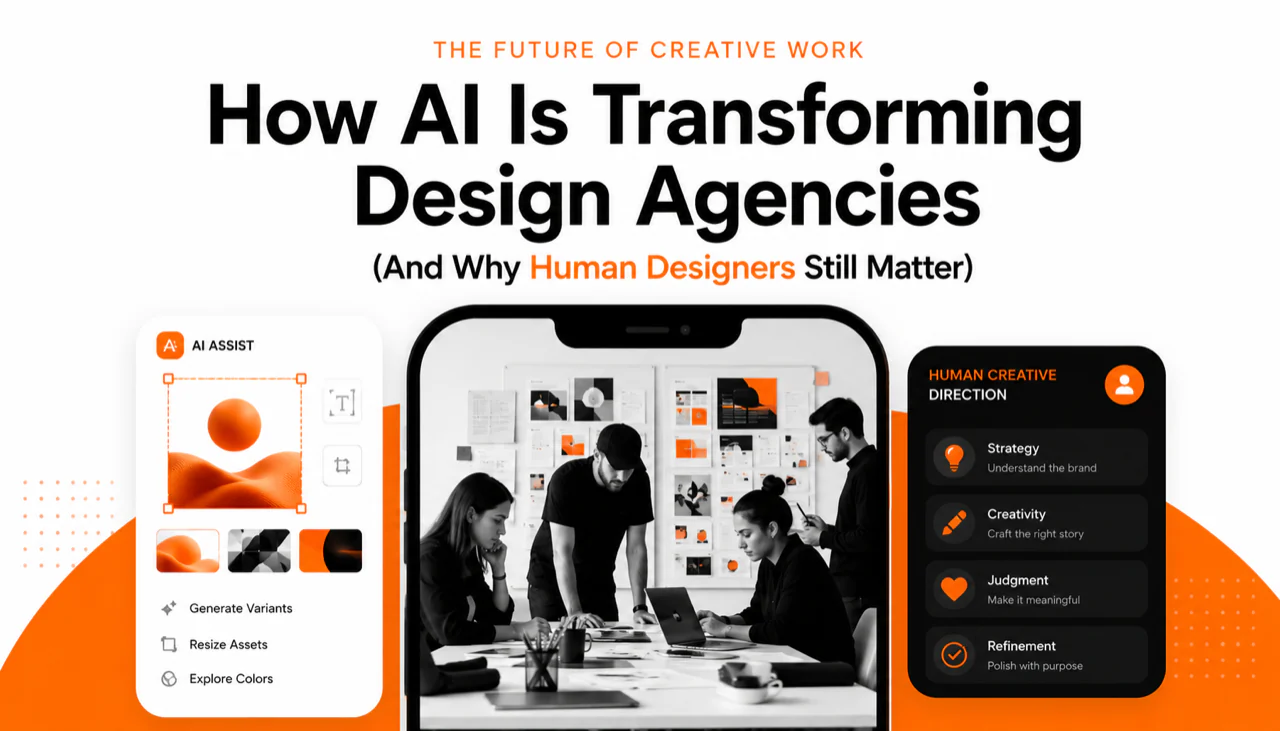
Eighteen months ago, we made a decision that nearly split the team. We were going to put AI agents in front of every senior designer. Not as a novelty. As infrastructure. The argument that almost killed it: 'this will turn us into a sweatshop dressed up as a creative team.' That argument was right, and also wrong. Here's how we navigated it.
What we automated
We started where every team starts: the unloved middle of the workflow. The brief intake. The first round of layout exploration. Resizing. Localisation. The first pass on a deck's icon set. The kind of work that takes a senior designer four hours and a junior eight, that nobody's ego is attached to, and that nobody's portfolio gets better from.
We built a small set of agents, one per task, that wrap the same three large language models we'd already been using personally. Each agent has a very specific job, a brand-tuned system prompt, and access to the project's brand kit in Que. The agents don't see the whole brief. They see the slice they're responsible for, and the brand context they need to stay on-spec.
Agents are infrastructure. They're not the team. The difference is the senior designer who decides what the agent is allowed to do.
Anjali Mehra
What we refused to automate
Three things, deliberately. The first creative direction call on a brand. The first review of any output. And the conversation with a founder. A founder paying for managed design deserves to talk to a human, not a chatbot. Period.
We also refused to automate critique. The senior designer doesn't ask the agent whether the work is good. The senior designer decides, then uses the agent to iterate faster. This is the difference between a team that uses AI and one that lets AI replace judgment.
How the workflow actually works
- A founder posts a request in Que with a one-line brief and any reference assets.
- The intake agent parses the brief, identifies missing context, and asks one or two clarifying questions if needed.
- Once the brief is complete, the agent produces three layout directions in our brand grid.
- A senior designer reviews the three. Picks the one with the strongest direction. Discards the other two.
- The designer iterates by hand on the chosen direction. The agent assists on resizing, asset variations, and copy localisation.
- Creative director reviews the final. Senior designer ships.
Total time, brief to delivery: 18 hours, on average. Without agents, the same work used to take us 56. The senior designer is still the senior designer. The agent is the team of two juniors that doesn't exist.
What 18 months of data looks like
- 3.1× more requests handled per senior designer per week.
- Quality scores from our internal review rubric: up 4 points on a 100-scale.
- Founder satisfaction (NPS): +12 over the prior 12-month baseline.
- Senior designer attrition: zero. (Three new hires, all by referral from existing seniors.)
The last metric is the one that matters. If senior designers were quietly leaving, the model wouldn't work. They aren't. They're shipping more, doing better work, and, by their own report, enjoying it more. The agents took the work they didn't want and gave it back to them as time.
What we'd tell a team considering this
Don't start with the agents. Start with the workflow. Map every task in your delivery process by hand on a wall, and circle the ones nobody's ego is attached to. Those are the candidates. Build agents for them, one at a time, with a senior designer at the wheel of every output. If you start with the agents, you'll automate the wrong things and end up with a team that ships more bad work, faster.